Last updated: July 2026
Ask two contractors whether to use a concrete or plastic drainage pipe and you will get two confident, opposite answers. The truth is simpler: neither material is "better" — each wins in specific situations. As a manufacturer of RCC spun pipes since 1998, we obviously sell concrete. But we have supplied enough gram panchayat and contractor projects across Karnataka to know that an honest answer earns more trust than a sales pitch. So here is the RCC vs HDPE pipes comparison the way we would explain it across the table, plastic's wins included.
Quick Summary
- RCC wins: pipes under roads with shallow cover, larger diameters (roughly 450 mm and above) on cost, gravity drainage and culverts, theft-prone rural sites, long design life with minimal attention.
- Plastic (HDPE/PVC) wins: lightweight handling and fast laying, small diameters, pressure applications, chemically aggressive effluents, sites with no crane or JCB access.
1. Structural Strength Under Traffic — RCC Wins
This is the single biggest difference. An RCC pipe is a rigid pipe: it carries the load of soil and vehicles through its own reinforced concrete wall. An HDPE pipe is a flexible pipe: it deflects under load and depends on well-compacted soil around it to hold its shape. That works when the trench is deep and the backfill is engineered and compacted in layers — conditions that are rarely achieved on a village cross-drain laid with 300–600 mm of cover and tractors, tippers and lorries passing over it from day one.
Under shallow cover and heavy wheel loads, a correctly classed RCC pipe is the safer, more forgiving choice. IS 458:2021 grades non-pressure concrete pipes by duty: NP2 (light duty) for drains and culverts under light traffic, NP3 (medium duty) for medium traffic, and NP4 (heavy duty) for heavy traffic such as national highways. Each class must pass a three-edge bearing test — a defined crushing load applied along the pipe crown — so the strength is designed in, not hoped for. Our NP2 vs NP3 guide explains how to pick the class.
2. Design Life — RCC Wins, With a Condition
A concrete pipe of the correct class, laid on proper bedding with sound joints, typically gives a service life of 50 years or more — that is how RCC drainage lines built decades ago are still performing across India. Note the framing: this is typical service life under correct installation, not a warranty. Concrete does not soften with heat, creep under sustained load, or degrade in sunlight; it actually continues gaining strength for years after casting.
HDPE is also a long-life material — manufacturers commonly design for around 50 years too — but its life assumptions depend on temperature and sustained stress, and plastic creeps under long-term load. For a buried gravity drain that nobody will inspect for decades, concrete's indifference to heat, sunlight and load is a real advantage.
3. UV and Heat Exposure — RCC Wins
Plastic pipes stored in an open yard for months, or laid with ends exposed at culvert mouths, degrade under UV and become brittle; dark HDPE also gets noticeably softer in the 40 °C+ summer sun common in interior Karnataka. Concrete simply does not care. Pipes can sit in a stockyard for a season awaiting the work order — a routine reality in tender-driven projects — with no loss of quality.
4. Floating and Anchorage — RCC Wins
An empty plastic pipe in a waterlogged trench floats. During monsoon works, HDPE lines that are not backfilled the same day can lift out of alignment overnight, and buried plastic lines in high water-table areas need anchoring or concrete surround. An RCC pipe weighing several hundred kilograms stays exactly where you laid it. For tank bunds, low-lying fields and monsoon-season culvert work, this alone decides the choice for many contractors.
5. Cost Per Metre — Depends on Diameter
Here the honest answer cuts both ways. At small diameters (110–315 mm), plastic is often cheaper installed, because the pipe is cheap, light and fast to lay. But plastic pricing rises steeply with diameter — a large flexible pipe needs a much thicker (or structured) wall to keep stiffness, and it is priced on polymer weight. Concrete scales far more gently. From about 450 mm upwards, RCC usually costs less per metre, and by 900–1200 mm the difference is substantial.
For orientation, indicative market ranges for IS 458 RCC pipes (per 2.5 m pipe, ex-factory, excluding GST and transport):
| Diameter | NP2 class (₹ per 2.5 m pipe) | NP3 class (₹ per 2.5 m pipe) |
|---|---|---|
| 450 mm | ₹1,400 – ₹2,400 | ₹2,400 – ₹3,300 |
| 600 mm | ₹2,400 – ₹3,800 | ₹3,800 – ₹5,200 |
| 900 mm | ₹5,000 – ₹7,500 | ₹6,500 – ₹9,500 |
| 1200 mm | ₹9,500 – ₹14,000 | ₹10,000 – ₹15,000 |
6. Installation and Handling — Plastic Wins
No argument here. A 6 m length of HDPE can be shoulder-carried by two workers; a 900 mm RCC pipe needs a JCB, tractor-loader or crane, stronger trench edges, and more care while lowering. Plastic also arrives in long lengths, meaning fewer joints and faster progress. If your site has no machine access — a narrow lane, a hill path, paddy bunds — plastic may be the only practical option regardless of every other point in this article. Where machines are already on site (as on most culvert and drainage contracts), the handling difference shrinks to a line item. Our installation guide covers safe handling and bedding for concrete pipes.
7. Joints — Roughly Even, Different Strengths
IS 458 concrete pipes come with three joint options: spigot & socket with a rubber ring (flexible, watertight — used for sewer and stormwater lines), collar joints (a precast concrete collar over plain ends, gap filled with cement mortar or bitumen mastic — the standard for NP2 culverts), and flush joints giving a smooth internal surface (used on NP3/NP4 culvert work). Rubber-ring concrete joints accommodate minor settlement well.
HDPE's butt-fusion welding produces a genuinely monolithic, zero-leak pipeline — excellent for pressure mains — but it needs a fusion machine, electricity and a trained operator at site. For gravity drainage, both systems are proven; for pressure duty, welded HDPE has the edge, and for simple culvert work, a mortar-filled collar joint that any local mason can make has its own practical charm.
8. Theft and Vandalism — RCC Wins (An Underrated Point)
Ask anyone who has stored pipes at a remote rural site. HDPE and PVC have resale and scrap value, can be cut with a hand tool, and disappear from unattended stockyards and even from laid, uncovered trenches. A concrete pipe has no scrap value, cannot be lifted without a machine, and is of no use to anyone once cut. For gram panchayat works where material may sit at site for weeks between measurement and laying, this is a genuine cost-risk difference that never appears on the comparative statement.
9. Sustainability — Mixed, Slight Edge to RCC in This Duty
Fairness both ways: cement production is carbon-intensive, and concrete is heavy to transport — plastic is lighter to haul and HDPE is recyclable in principle. But a locally manufactured concrete pipe (ours travel from Kunigal or Tiptur, not from a distant polymer plant) that serves 50+ years without replacement, sheds no microplastics into stormwater, and can be crushed into inert fill at end of life is a defensible environmental choice for drainage duty. The greenest pipe is the one you never have to dig up and replace.
Verdict: Which Pipe for Which Job?
| Use-case | Better choice | Why |
|---|---|---|
| Road cross-drain / culvert, shallow cover | RCC | Rigid pipe carries wheel loads; class chosen per IS 458 duty |
| Village / town storm drainage ≥450 mm | RCC | Lower cost per metre at large diameters; 50+ year typical life |
| Gravity sewer line | RCC (rubber-ring joints) | Watertight flexible joints, no floating, long life |
| Pressure water main / pumped line | HDPE | Welded joints handle internal pressure; NP-class RCC is gravity-only |
| Small-bore drain (<300 mm), no machine access | PVC/HDPE | Light, cheap at small sizes, hand-laid |
| Chemically aggressive industrial effluent | HDPE | Superior chemical resistance |
| Remote rural site, material stored in open | RCC | No theft value, no UV degradation in storage |
| High water-table / monsoon-season laying | RCC | Self-weight prevents floating and misalignment |
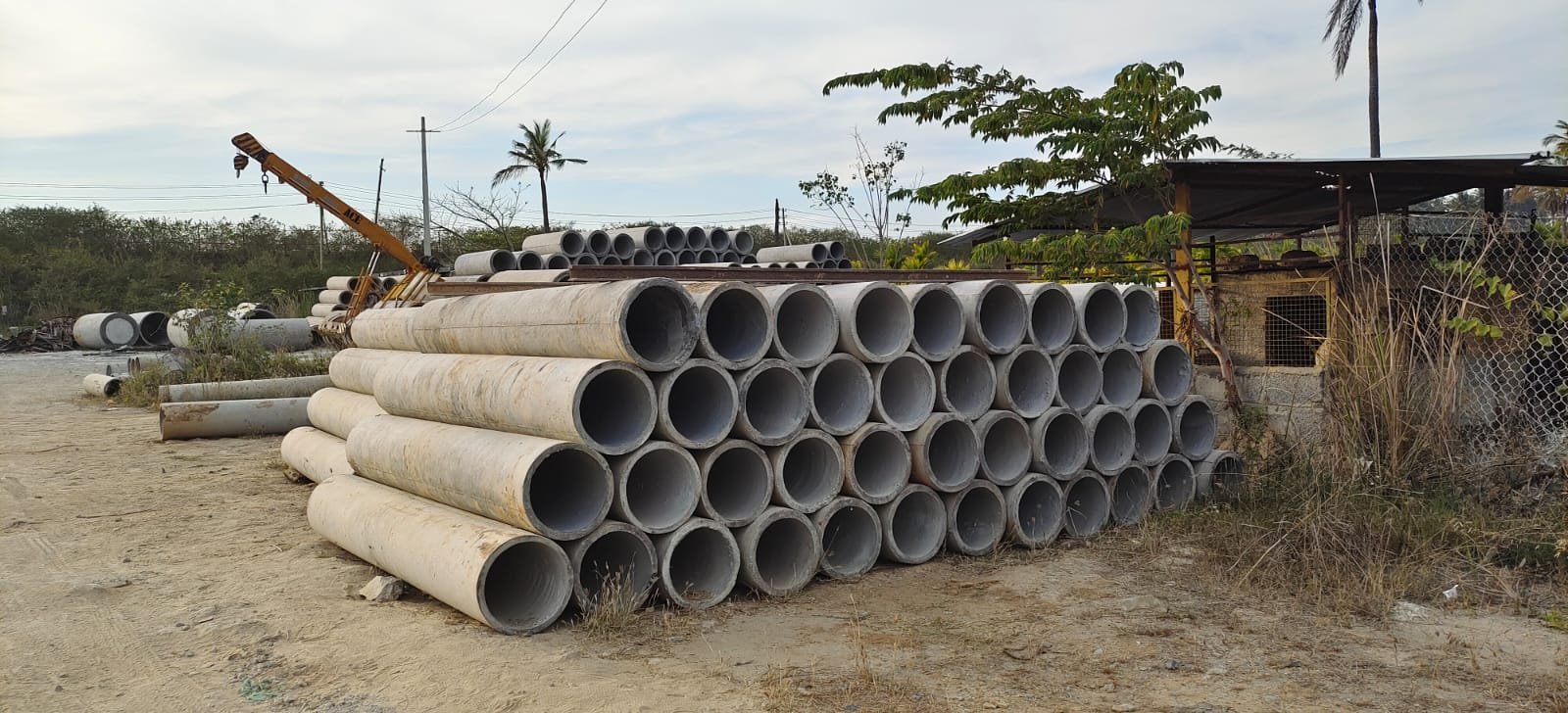
Where BKN Fits In
BKN Group of Industries has manufactured RCC spun pipes at Kunigal since 1998 — 300 mm to 1600 mm diameter at Kunigal, and up to 1200 mm at our Tiptur unit, in NP2 (light duty) and NP3 (medium duty) classes, manufactured as per IS 458 standards. Every pipe is spun-cast (centrifugal casting) with controlled batching, proper water curing, and dimensional and visual inspection before despatch. Wall thickness, reinforcement and load values follow the IS 458 tables — detailed spec sheet available on request. We serve contractors, gram panchayats and government tender supplies across Tumkur, Hassan, Chikmagalur, Chitradurga and wider Karnataka.
Frequently Asked Questions
What is the life of an RCC pipe?
A correctly classed, correctly installed RCC pipe manufactured as per IS 458 typically serves 50 years or more in drainage and culvert duty. This is typical field service life, not a warranty — bedding quality, backfill, traffic loads and soil conditions all matter, which is why installation deserves as much attention as the pipe itself.
Which is cheaper — RCC or HDPE pipe?
At small diameters (up to about 300 mm), plastic is often cheaper installed. From roughly 450 mm upwards, RCC usually costs less per metre, and the gap widens with diameter. Always compare full installed cost — pipe, transport, machinery, jointing and bedding — not just the pipe rate.
Can HDPE pipes take traffic loads under roads?
They can, if buried deep with properly engineered, layer-compacted backfill — the pipe relies on the surrounding soil for its strength. With shallow cover under wheel loads, which is the typical rural cross-drain situation, a rigid RCC pipe of the correct IS 458 class is the safer choice because its strength is in the pipe wall itself.
Do RCC pipes get stolen like plastic pipes?
Rarely. Concrete pipes have no scrap or resale value and cannot be moved without machinery, so pipes stored at remote sites or laid in open rural areas face far less theft and vandalism risk than plastic, which can be cut, carried and resold.
Need RCC pipes for your project?
Factory-direct prices from our Kunigal & Tiptur units. Serving all of Karnataka since 1998.
📞 7760337303💬 WhatsApp UsRelated Guides
- NP2 vs NP3 Pipes — how to choose the right IS 458 duty class for your traffic and cover conditions.
- RCC Pipe Price Guide — indicative diameter-wise price ranges and what drives the final quote.
- Culvert Pipe Selection Guide — sizing, class and joint selection for road cross-drains.
- How RCC Spun Pipes Are Manufactured — inside the centrifugal casting and curing process at our plants.