Last updated: July 2026
If you have ever wondered how RCC pipes are made — why a spun "hume" pipe rings when you tap it, why its inner surface is so smooth, and why curing days matter more than most buyers realise — this guide walks you through the entire hume pipe manufacturing process. We have been running spun pipe plants at Kunigal (since 1998) and Tiptur, Karnataka, so everything below is written from the factory floor, not from a textbook.
The Centrifugal Spinning Method: Why It Makes a Stronger Pipe
A spun pipe is made by rotating a steel mould at high speed while concrete is fed inside it. Centrifugal force flings the concrete outward and presses it hard against the mould wall. Three good things happen at once:
- Compaction: the spinning force squeezes air voids out of the mix, giving a dense, low-porosity wall. Dense concrete resists water penetration and lasts decades underground.
- Water expulsion: excess mixing water migrates to the inner surface and is drained off. A lower effective water-cement ratio means higher strength for the same cement content.
- Smooth bore: the inner surface is trowelled while still spinning, producing the smooth bore that gives concrete pipes their good flow characteristics.
This is why the centrifugal method has been the standard way of making reinforced concrete pipes in India for close to a century, and why the trade still calls them "hume pipes" after the Hume brothers who patented the process. All our pipes — NP2 and NP3 classes — are manufactured as per IS 458:2021 (Precast Concrete Pipes, with and without reinforcement) specifications using this spun process.
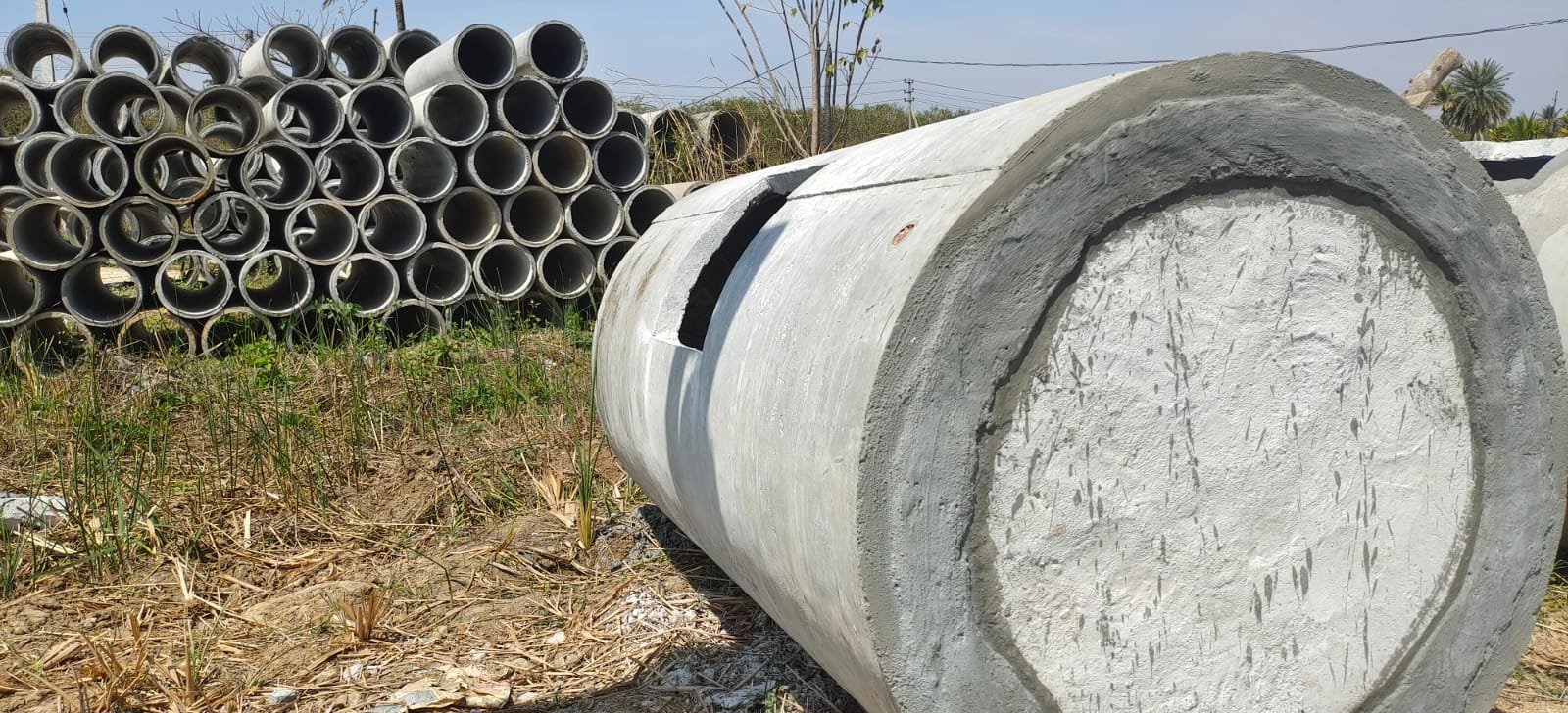
The Spun Pipe Manufacturing Process, Step by Step
Step 1: Making the Reinforcement Cage
Every reinforced pipe starts as a steel cage. Hard-drawn steel wire is wound in a spiral (the circumferential reinforcement that resists crushing loads) over straight longitudinal wires (which hold the spiral in position and resist handling stresses). The spiral pitch, wire diameter and steel quantity depend on the pipe's diameter and class — NP3 pipes carry more steel than NP2 of the same size, which is what gives them their higher load rating. Exact reinforcement quantities are as per IS 458 tables — detailed spec sheet available on request.
Quality checkpoint: we check wire diameter, spiral pitch and cage dimensions before any cage goes near a mould. A cage that is undersized or has an irregular pitch is scrapped — reinforcement is the one thing you cannot fix after casting.
Step 2: Mould Preparation
The steel mould is split into two halves. Each half is cleaned of old concrete, coated with a release oil, and the two halves are bolted together around the reinforcement cage. Spacers hold the cage centrally so that concrete cover is uniform — if the cage drifts to one side, the steel ends up too close to the surface where it can corrode.
Quality checkpoint: mould roundness, joint tightness and cage centring. A worn or badly bolted mould produces an oval pipe with slurry fins along the seam — one of the tell-tale signs of a careless plant.
Step 3: Batching the Concrete — the Controlled Mix
Pipe concrete is not ordinary site concrete. It is a rich, controlled mix — cement, well-graded crushed aggregate and sand, batched in fixed proportions with a deliberately low water content. The spinning process will compact it, so the mix does not need to be flowable; it needs to be consistent, batch after batch.
Quality checkpoint: this is where our in-house quality control does its most important work. We control batch proportions, check aggregate cleanliness and moisture, and keep the water-cement ratio tight. Inconsistent batching is the root cause of weak patches and honeycombing in finished pipes.
Step 4: Spinning (Centrifugal Casting)
The loaded mould is placed on the spinning machine rollers. Concrete is fed in while the mould rotates, first at a slower charging speed, then at high speed for compaction. Centrifugal force packs the concrete against the mould, excess water bleeds to the bore and is drained, and the inner surface is finished smooth. The whole spin takes only minutes, but the operator's judgement — feed rate, spin duration, finishing — decides the quality of the wall.
Quality checkpoint: wall thickness is checked at the pipe ends against the IS 458 requirement for that diameter and class, and the bore is inspected for a uniform, smooth finish.
Step 5: Demoulding
After initial setting, the mould bolts are opened and the two halves are carefully stripped away. The green pipe is strong enough to hold its shape but nowhere near its final strength, so handling at this stage is gentle and deliberate.
Quality checkpoint: first full visual inspection — ends checked for squareness and damage, surface checked for honeycombing, voids or exposed reinforcement. Defective pipes are rejected here, before any curing effort is spent on them.
Step 6: Water Curing — Why Curing Days Matter
Curing is the least glamorous and most important step in the entire process. Concrete gains strength through hydration — a slow chemical reaction between cement and water. If the pipe dries out early, hydration simply stops, and no amount of time afterwards brings the lost strength back.
So pipes are kept continuously wet — sprinkled or ponded — for the full curing period before they move to the stacking yard. A pipe that is dispatched green may look identical to a fully cured one, but it will crack under handling, backfilling or traffic loads. When you compare quotes, ask every supplier how long their pipes are cured; a suspiciously fast delivery promise on freshly cast pipes usually means shortened curing.
Step 7: Inspection and Stacking
Cured pipes get a final dimensional and visual inspection: internal diameter, wall thickness at ends, length, end squareness, and surface condition. Passed pipes are marked with class and size, then stacked in the yard on level ground with proper packing, ready for loading.
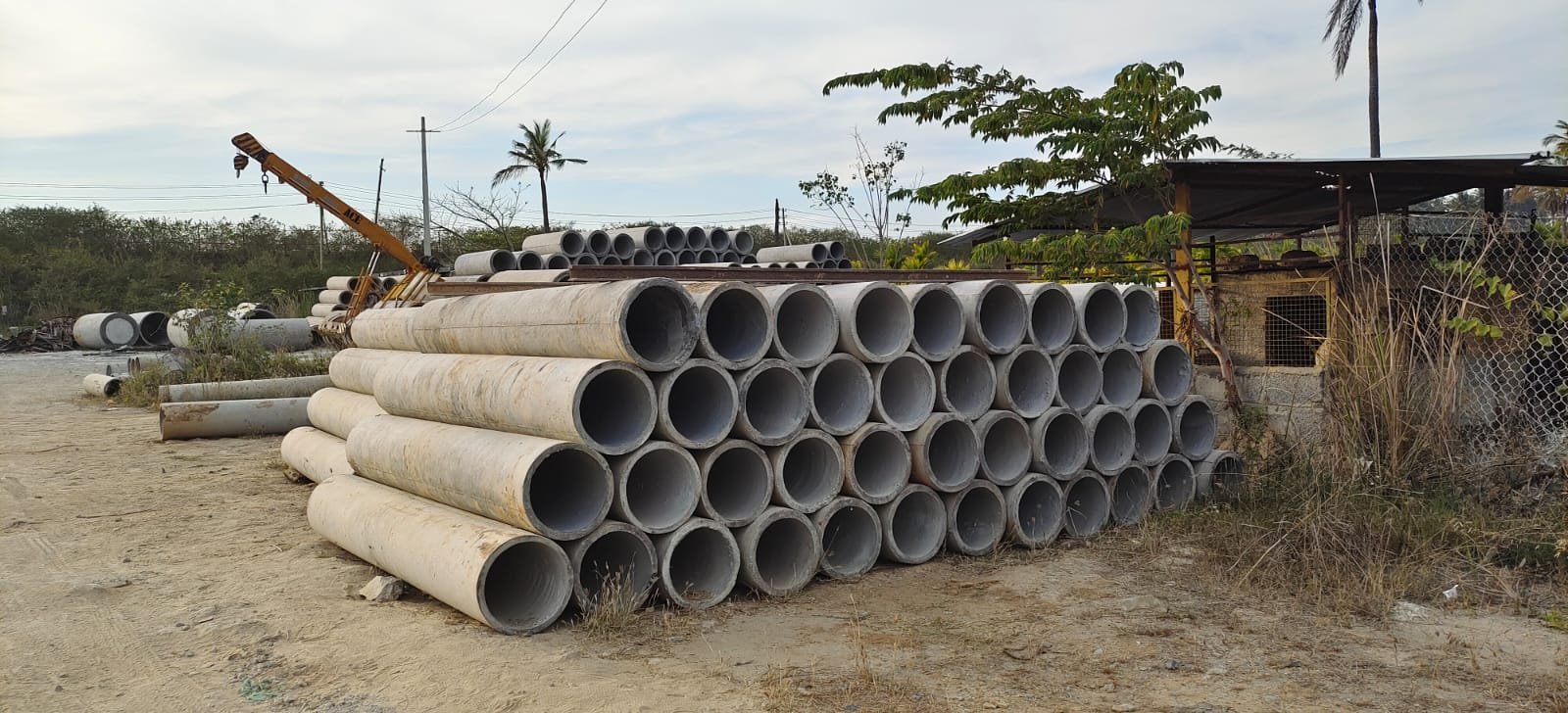
Quality Checkpoints at a Glance
Here is an honest summary of the in-house quality control we run at each stage. We do not operate a certified test laboratory — what we do is disciplined process control, which is where most pipe quality is actually won or lost:
| Stage | What is checked | Why it matters |
|---|---|---|
| Cage making | Wire size, spiral pitch, cage dimensions | Steel decides the pipe's load capacity |
| Mould prep | Cleanliness, roundness, cage centring | Uniform cover; round, true pipe |
| Batching | Mix proportions, aggregate quality, water content | Prevents weak zones and honeycombing |
| Spinning | Spin time, wall thickness, bore finish | Dense, impermeable wall |
| Demoulding | Visual check for defects, end condition | Rejects caught early |
| Curing | Continuous wetting for the full period | Full design strength development |
| Final inspection | Dimensions, ends, surface, marking | Only sound pipes leave the yard |
For context: IS 458 itself specifies formal acceptance tests such as the three-edge bearing test (a line load applied along the pipe crown until a specified crack or ultimate load, which is what defines the NP2/NP3 strength classes), the hydrostatic test (internal water pressure held to check leakage), and permeability and water absorption tests that verify concrete density. Understanding what these tests measure helps you understand why every step above exists — a pipe only passes a three-edge bearing test if the cage, the mix, the spinning and the curing were all done right. You can read more in our plain-language guide to IS 458.
Spun Pipes vs Vertically Cast Pipes
Concrete pipes can also be made by vertical casting — pouring concrete into a standing mould and compacting it with vibration. Both methods can produce pipes to IS 458, but they behave differently in practice:
| Aspect | Spun (centrifugal) pipe | Vertically cast pipe |
|---|---|---|
| Compaction | Centrifugal force — uniform, high density around the full circumference | Vibration — depends heavily on operator care; risk of uneven compaction |
| Water-cement ratio | Excess water spun out, lowering effective ratio | All mixing water stays in the wall |
| Bore finish | Smooth, machine-finished bore; better flow | Generally rougher internal surface |
| Wall uniformity | Very uniform thickness | Can vary if the core shifts |
| Typical use | Standard for NP-class drainage and culvert pipes across India | More common for very large or special sections |
For the NP2 and NP3 drainage, irrigation and culvert pipes that most contractors and gram panchayats buy, the spun process is the established choice — which is why practically every "hume pipe" you see on Karnataka work sites is a spun pipe.
What Buyers Should Look For in a Well-Made Pipe
You do not need a laboratory to spot a well-made spun pipe in the yard. Check these five things:
- Surface finish: a dense, even outer surface with no honeycombing (patches of exposed aggregate with voids between the stones). Honeycombing means poor compaction or poor batching, and it is a path for water to reach the steel.
- Ends: square, clean, undamaged ends. Chipped or ragged ends make jointing difficult and often indicate rough handling of green pipes.
- The ring test: tap the pipe wall with a hammer or metal rod. A fully cured, dense pipe gives a clear metallic ring; a dull thud suggests poor compaction, cracks or incomplete curing.
- No visible steel: reinforcement should never show at the surface. Exposed wire means the cage was off-centre — that steel will rust and the pipe will fail early.
- Uniform bore: look through the pipe — the bore should be smooth and the wall thickness at both ends visibly even all round.
Frequently Asked Questions
How long does it take to manufacture an RCC spun pipe?
The spinning itself takes only minutes, but a pipe is not ready for site until it has finished its full water-curing period. From cage to a cured, inspected pipe, allow roughly two to four weeks depending on the curing schedule. This is why serious buyers plan pipe procurement ahead of the work — and why we never dispatch green pipes to meet a deadline.
Is a hume pipe the same as a spun pipe?
Yes. "Hume pipe" is simply the common Indian trade name for a reinforced concrete pipe made by the centrifugal (spun) casting process, named after the Hume brothers who patented it. Both terms describe the same product, manufactured as per IS 458 specifications.
Why does water curing matter so much?
Concrete gains strength through hydration, which needs continuous moisture. A pipe that dries out early never reaches its design strength, no matter how good the mix was — and the damage is invisible until the pipe cracks under load. Curing discipline is one of the clearest differences between a reliable plant and a cheap one.
Which classes and sizes does BKN manufacture?
We manufacture NP2 and NP3 class spun pipes as per IS 458 — 300 mm to 1600 mm at our Kunigal unit (running since 1998) and up to 1200 mm at Tiptur. See our NP2 vs NP3 guide to choose the right class for your site.
Need RCC pipes for your project?
Factory-direct prices from our Kunigal & Tiptur units. Serving all of Karnataka since 1998.
📞 7760337303💬 WhatsApp UsRelated Guides
- NP2 vs NP3 Pipes — which class your drainage or culvert job actually needs, explained simply.
- IS 458 Standard Explained — the Indian standard for precast concrete pipes in plain language.
- RCC Pipe Price Guide — indicative ex-factory price ranges by diameter and class.
- RCC Pipe Installation Guide — trenching, bedding, jointing and backfilling done right.