Last updated: July 2026
What is IS 458, and why should a buyer care?
IS 458 is the Bureau of Indian Standards (BIS) specification for precast concrete pipes, with and without reinforcement. The current edition is IS 458:2021, which superseded the earlier 2003 version. When an engineer writes "RCC pipes as per IS 458" in a tender or a bill of quantities, this is the document being referred to.
For a contractor or panchayat engineer, the IS 458 concrete pipe standard matters for a simple reason: it turns a vague purchase ("concrete pipe, 600 mm") into a precise one. IS 458 defines pipe classes by strength and use, fixes dimensions and tolerances, sets minimum material and reinforcement requirements, and lays down the tests a pipe must pass. If two suppliers quote for "600 mm NP3 as per IS 458", you are comparing like with like — and if a delivered pipe falls short, the standard gives you an objective yardstick to reject it against.
One clarification worth making early: IS 458 is the technical standard itself, not a certificate. Whether a particular manufacturer additionally holds a formal BIS licence is a separate matter — more on that honestly, from our own position, further down.
Scope: the pipe classes under IS 458
IS 458 covers precast concrete pipes in two broad families — pressure pipes (P classes) and non-pressure pipes (NP classes). "Non-pressure" means the pipe carries flow by gravity only, as in drains and culverts; "pressure" means the pipe is designed and hydrostatically tested to carry water under internal pressure.
| Class | Type | Duty | Typical use |
|---|---|---|---|
| NP1 | Unreinforced, non-pressure | Light | Drainage and irrigation above ground or in shallow trenches |
| NP2 | Reinforced, non-pressure | Light-duty | Drainage, irrigation, cross drains and culverts under light traffic |
| NP3 | Reinforced, non-pressure | Medium-duty | Drainage, irrigation, cross drains and culverts under medium traffic |
| NP4 | Reinforced, non-pressure | Heavy-duty | Culverts and cross drains under heavy traffic, e.g. national highways |
| P1, P2, P3 | Reinforced, pressure | Increasing test pressure | Water supply lines carrying flow under internal pressure |
In practice, the vast majority of drainage, irrigation and culvert work in Karnataka uses NP2 and NP3. NP4 exists in the standard for heavy-traffic situations such as national highway culverts, and the P classes serve pressurised water supply — both are described here for completeness of the standard's scope. For a deeper comparison of the two workhorse classes, see our NP2 vs NP3 guide.
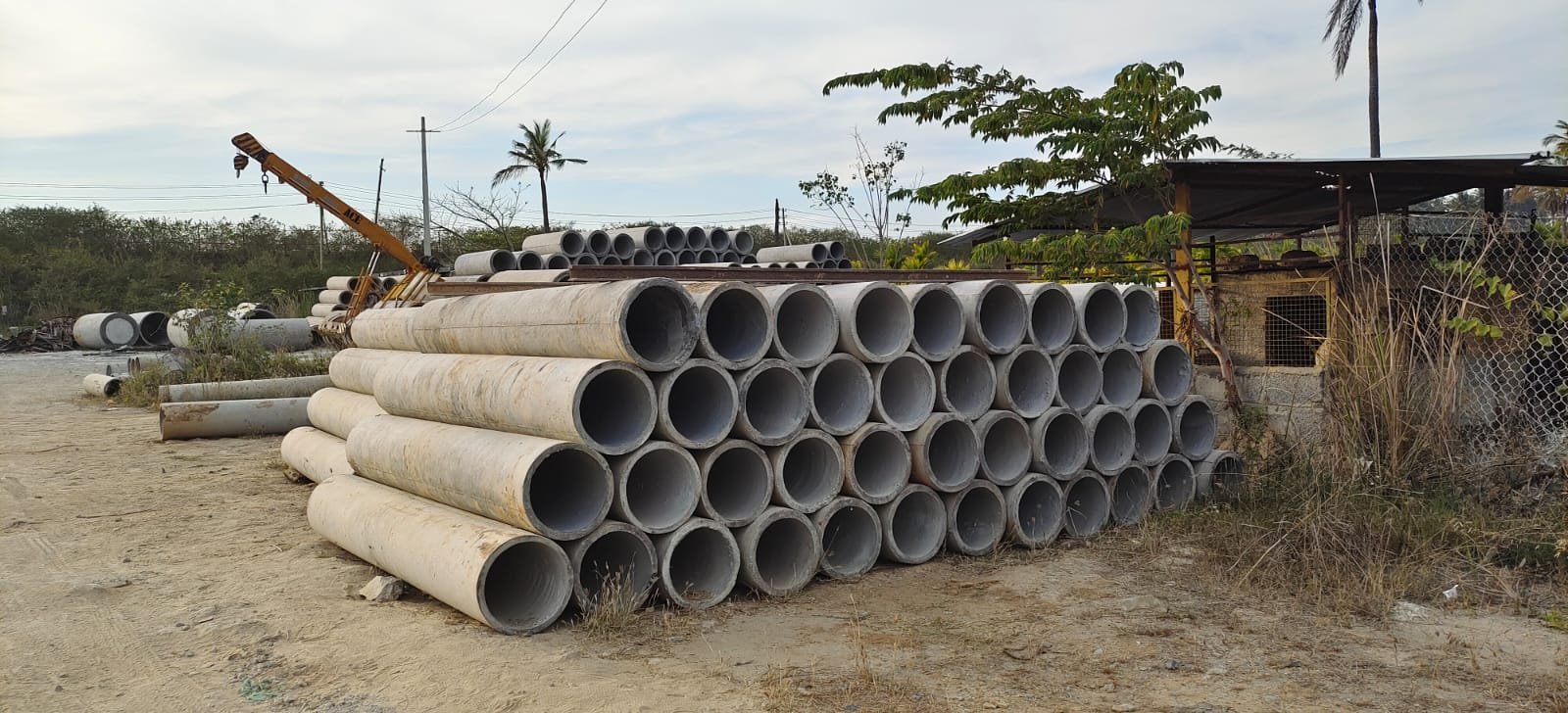
What the IS 458 specifications actually cover
Materials
IS 458 sets requirements for the ingredients of the pipe: the cement, aggregates, water and steel used must themselves conform to the relevant Indian standards, and the concrete must achieve the strength specified for the pipe class. This is why controlled batching matters — a pipe is only as good as the mix that goes into it.
Reinforcement
For reinforced classes (NP2 upwards and all P classes), the standard specifies the reinforcement cage — the amount, arrangement and cover of longitudinal and spiral steel for each diameter and class. A 900 mm NP3 pipe carries substantially more steel than a 900 mm NP2 pipe; that steel is what earns it the higher strength rating. Exact steel quantities per diameter are given as per IS 458 tables — detailed spec sheet available on request.
Dimensions and tolerances
The standard fixes internal diameters, barrel wall thicknesses and permissible tolerances on each. As a guide to the ranges involved: NP2 barrel wall thickness runs from roughly 25 mm at the smallest diameters up to about 110 mm at 2200 mm diameter, and NP3 from roughly 25 mm up to about 215 mm at its largest sizes — with the exact value for each diameter and class taken as per IS 458 tables. Standard effective lengths are 2.0 m and 2.5 m, with longer lengths up to 4 m permitted by IS 458 for larger-diameter collar-jointed pipes. Tolerances on diameter, wall thickness and length keep pipes from different batches — or even different factories — interchangeable on site.
Joints
IS 458 covers three joint types: the spigot & socket joint (plain spigot end fitting into an enlarged socket end, sealed with a rubber ring — a flexible joint), the collar joint (both pipe ends plain, with a separate precast concrete collar placed over the junction and the annular gap filled with cement mortar or bitumen mastic), and the flush joint (tongue at one end, groove at the other, giving a smooth internal surface). Flexible rubber-ring joints are required for all pressure pipes and for most non-pressure lines; collar-jointed NP2 and flush-jointed NP3/NP4 pipes are the usual choice for road culverts and cross drains.
Workmanship and finish
Finally, the standard sets workmanship requirements: pipes must be free of defects such as cracks, honeycombing and exposed reinforcement, with sound, even surfaces inside and out. A visual and dimensional check against these requirements is the first line of quality control at any good pipe yard.
The tests IS 458 defines
IS 458 backs its specifications with physical tests. Understanding what each test proves helps you read a spec sheet — and ask the right questions of any supplier.
Three-edge bearing test. The pipe is laid horizontally on two bottom bearing strips and a load is applied along the crown — the top line of the pipe — until the specified crack load and ultimate load are reached. This is the test that fixes a pipe's strength class: an NP3 pipe must carry a higher load than an NP2 pipe of the same diameter before cracking. Per the BIS product manual, three-edge bearing (ultimate load) testing is carried out on sampled control units — for example, every 10th control unit for sizes up to and including 600 mm. Required load values are as per IS 458 tables — detailed spec sheet available on request.
Hydrostatic test. The pipe is filled with water and internal pressure is applied and held for a set period, during which the pipe must show no leakage. This is the defining test for the pressure classes (P1–P3), where each class corresponds to a higher test pressure.
Water absorption test. Samples cut from the pipe wall are dried, weighed, soaked in water and weighed again. The percentage of water absorbed must stay within the limit set by the standard — a low figure indicates dense, well-compacted concrete that will resist weathering and chemical attack over decades of buried service.
Permeability test. Water under a standing head is applied to the pipe wall and the quantity seeping through over a set time is measured. Where absorption checks the concrete's density as a material, permeability checks the finished wall's imperviousness — critical for a drain that must not leak sewage into the surrounding soil or let groundwater seep in. Like the three-edge bearing test, it is applied to sampled control units.
How to use IS 458 when ordering pipes
A complete, unambiguous pipe order under IS 458 specifies four things:
- Class — NP2 for light-traffic drainage and culverts, NP3 for medium-traffic work; match the class to the loading your site will actually see. If unsure, our culvert pipe selection guide walks through the decision.
- Nominal internal diameter — sized to the design flow, e.g. 300 mm, 600 mm, 900 mm, 1200 mm.
- Joint type — spigot & socket (rubber ring) where flexible watertight joints are needed; collar or flush joints for culvert and cross-drain work. State whether collars are to be supplied along with the pipes.
- Effective length — usually 2.0 m or 2.5 m; confirm the effective (laid) length so the number of pieces matches your chainage.
So a well-written line item reads: "RCC spun pipes, 600 mm dia, class NP3, flush jointed, 2.5 m effective length, as per IS 458." Add the quantity in running metres or pieces, and every supplier will quote on the same basis. For budgetary figures before you call for quotes, see our RCC pipe price guide — note that all published prices are indicative, ex-factory, and vary with cement & steel prices, so call for today's rate.
Where BKN stands on IS 458 — stated honestly
BKN Group of Industries has manufactured RCC spun pipes at Kunigal since 1998, and also runs a second unit at Tiptur. Our position, plainly:
- We manufacture NP2 and NP3 class pipes as per IS 458 specifications — 300 mm to 1600 mm diameter at Kunigal, and up to 1200 mm at Tiptur. We do not make pressure classes or NP4.
- Pipes are produced by the spun (centrifugal) casting method, which compacts the concrete densely against the mould. You can read how this works in our manufacturing process guide.
- Quality is controlled in-house: controlled batching of the concrete mix, proper water curing, and dimensional and visual inspection of pipes against IS 458 requirements before despatch.
- We do not hold a BIS licence and we do not claim ISI marking. Buyers whose tender conditions specifically require a BIS-licensed source should check that condition before ordering. For the large volume of drainage, irrigation and culvert work specified simply as "pipes as per IS 458", our pipes are built to those specifications, and we are happy to share dimensional details and answer technical questions openly.
Frequently asked questions
Is IS 458 the same as an ISI mark or BIS certification?
No. IS 458 is the technical standard — the document defining classes, materials, dimensions and tests. BIS certification is a separate formal licensing process. A manufacturer can build pipes to IS 458 specifications without holding a BIS licence. BKN manufactures its NP2 and NP3 pipes as per IS 458 specifications with strict in-house quality control, and states openly that it does not hold a BIS licence.
Which IS 458 classes does BKN manufacture?
NP2 (light-duty) and NP3 (medium-duty) non-pressure RCC spun pipes — 300 mm to 1600 mm diameter at Kunigal, up to 1200 mm at Tiptur. We do not manufacture pressure classes (P1–P3) or NP4.
What is the difference between NP2 and NP3 under IS 458?
Both are reinforced, non-pressure (gravity-flow) pipes. NP2 is the light-duty class, for drainage, irrigation and culverts under light traffic; NP3 is the medium-duty class, with heavier reinforcement and a higher required three-edge bearing load, for cross drains and culverts under medium traffic. NP4 is the heavy-duty class for heavy traffic such as national highways.
What lengths and joints does IS 458 allow?
Effective lengths of 2.0 m and 2.5 m are the common commercial sizes, and the standard permits longer lengths up to 4 m for larger-diameter collar-jointed pipes. Three joint types are covered — spigot & socket (rubber ring), collar, and flush — with collar and flush joints the usual choice for culvert and cross-drain work.
Need RCC pipes for your project?
Factory-direct prices from our Kunigal & Tiptur units. Serving all of Karnataka since 1998.
📞 7760337303💬 WhatsApp UsRelated guides
- NP2 vs NP3 Pipes — which class your project actually needs, compared side by side.
- RCC Pipe Price Guide — indicative ex-factory price ranges by diameter and class.
- How RCC Spun Pipes Are Manufactured — the centrifugal casting process, step by step.
- Culvert Pipe Selection Guide — choosing diameter, class and joint for road crossings.